


This Day in Philosophy — 25 August: Hume and Nietzsche, on the same date
David Hume died in Edinburgh on 25 August 1776; Friedrich Nietzsche died in Weimar on 25 August 1900. A hundred and twenty-four years separate them, yet both shook reason's claim to ground itself, and both did it from the same place.

Newsroom
The Philosophers News editorial board.
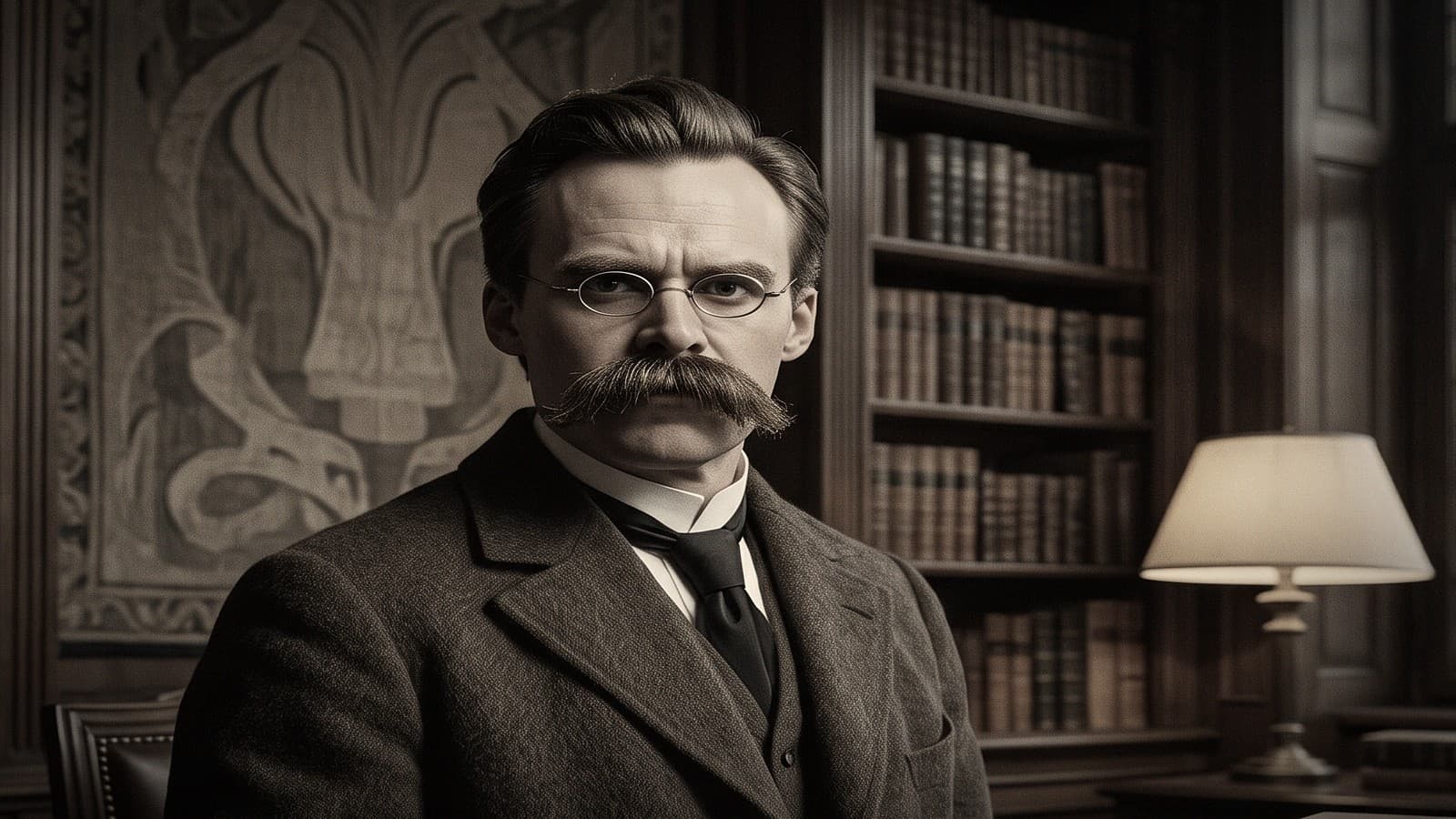
The coincidences a calendar throws up can open unexpected ways of reading the history of thought.
For philosophy, 25 August is one such day. David Hume died in Edinburgh on 25 August 1776; Friedrich Nietzsche died in Weimar on 25 August 1900. Exactly 124 years lie between them.
Setting the two side by side is more than a joke of the calendar. They share a move — and that move settled the direction of modern philosophy.
Hume: Edinburgh, 1776
Months before the end, Hume knew that his illness was advancing. Knowing it, he wrote the brief autobiography My Own Life; the text does not run to eight pages, and it is composed with a startling coolness.
His friend Adam Smith, who was present at his death, described those last days in a letter. What was unsettling about the account was this: Hume awaited death calmly, with no recourse to religious consolation. When the letter was published it caused Smith no end of trouble — by his own account it drew more hostility than the whole of his criticism of Britain's commercial system put together.
Hume's real charge, though, had been left to go off after his death. The Dialogues Concerning Natural Religion went unprinted in his lifetime because of the reaction publication would have provoked; they appeared in 1779, three years after he died.
What he did
Hume's destructiveness lies in his method, not in his manner. He carried the empiricist principle through to the end and asked: where in experience do our fundamental concepts find anything answering to them?
Causation. We see one billiard ball strike another; we do not see the first necessitate the second. What we see is succession. What we call “necessary connection” lies not in the object but in the habit that repetition forms in the mind.
The self. Look inward and we find a bundle of impressions — warmth, pain, a thought, a vexation. We never once meet an impression of an abiding “I” that carries them all.
Morals. He showed that arguments which pass from what is to what ought to be never explain the passage. The source of moral judgement, on his account, is not reason but sentiment: “Reason is, and ought only to be, the slave of the passions.”
In Kant's phrase, Hume woke him from his “dogmatic slumber”. He was not the only one Hume woke.
Nietzsche: Weimar, 1900
Nietzsche's death does not fall on the same date as the end of his intellectual life. After the collapse he suffered in Turin in January 1889 he never wrote again. The eleven and a half years that remained were spent in the care first of his mother and then of his sister Elisabeth.
There is a bitterness in those years: Nietzsche's fame broke out during precisely that period. When his name began to be spoken across Europe and his books to be reprinted, their author knew nothing of it.
Elisabeth Förster-Nietzsche took charge of her brother's archive. She assembled his notes in an order of her own choosing and issued them as a book under the title The Will to Power. Later philological work established that Nietzsche had abandoned any plan to publish such a book. That intervention bears a large part of the responsibility for the political abuse to which the text and the title were later put.
Two deaths, one line
There is no direct line of discipleship between Hume and Nietzsche. But they share a move, and the move altered philosophy's agenda.
Both showed that reason cannot lay its own foundation.
Hume did it on the side of knowledge. Causation, induction, the self — the load-bearing concepts of thought — cannot be grounded in reason. What holds them up is habit, repetition and human nature.
Nietzsche did it on the side of value. Our moral values are not principles discovered by reason but formations with a history. The genealogical method exists precisely in order to make that history visible.
The second thing they share is more striking still: both took morality away from reason and attached it to feeling. For Hume, moral approval is a sentiment; for Nietzsche, evaluation is the expression of a relation of power. Different vocabularies, one direction.
The difference between them is temperamental. After the demolition, Hume goes back to ordinary life; showing that our concepts are groundless does not appal him, and off he goes to play backgammon and dine with his friends. For Nietzsche the same emptiness is the scene of a crisis: what emerges once the groundlessness of values is recognised is a nihilism that must be overcome.
The same diagnosis, two temperaments. It is here that the two veins of modern philosophy divide.
In Turkish
Hume's An Enquiry Concerning Human Understanding, A Treatise of Human Nature and Dialogues Concerning Natural Religion have been translated into Turkish. Almost the whole of Nietzsche's principal work is available in Turkish; among the versions of On the Genealogy of Morality and Beyond Good and Evil are some that carry the name of Ahmet İnam.
Note: some sources give 26 August as the date of Hume's death. Britannica and the University of Edinburgh archive give 25 August 1776.
Related Stories

Clarke, Kelsen, Tschirnhaus, Zwingli and a letter on Roosevelt's desk: 11 October
Samuel Clarke, Newton's advocate against Leibniz, was born on 11 October 1675; Hans Kelsen, author of the Pure Theory of Law, on 11 October 1881. Tschirnhaus died on the date in 1708, Zwingli in battle in 1531, and in 1939 Alexander Sachs carried Einstein's letter into the Oval Office. The thread is where reason's reach ends and responsibility begins.
Charles Taylor, Scott J. Shapiro, Gottfried Wilhelm Leibniz, Robert Alexy


Comments
0Loading comments…